Showing posts with label Guest Playlist. Show all posts

Friday, January 10, 2014

Guest Playlist: Frank Zappa's Musical Evolution

Guest post from Kris Herbst:
I assembled this playlist of 401 Zappa tracks that, for me, represent his best and most accessible musical compositions (omitting tracks where I find the musical quality is secondary to comedy bits or commentary):  Frank Zappa's Musical Evolution (401 tracks, 19 hours).

To provide a sense of the progression of Zappa’s musical ideas and development, I have arranged the tracks in chronological order, based on when they were first recorded or performed, rather than by release date, with help from the discography and timelines in this site: http://globalia.net/donlope/fz/index.html.

I have grouped together alternative recordings of the same piece, in chronological order, always beginning with the first instance of a piece, followed by alternate recordings of that piece, and then followed by guitar solos from that piece, also in chronological order of performance. This groups recordings of guitar solos (which Zappa often released at later times, as separate pieces, with different names) with the piece in which they were originally performed.

Suggestions to improve it are welcome: kris at globalweb.org.

A little info about me: I became a Zappa fan in 1969, at the age of 13, when I was turned on to the "We're Only In It For The Money" album by my Boy Scout troopmaster. Two years later, I went to my first Zappa concert, when the band included Flo and Eddie and Ian Underwood. Listening to Zappa helped open my mind to exploring a wide range of music, especially jazz. I saw Zappa in concert once more, in 1974, fronting one of his best bands that included Napoleon Murphy Brock, Ruth Underwood, George Duke and Don Preston on keyboards, the Fowler brothers (Bruce, Walt, and Tom on trombone, trumpet, and bass, respectively), Jeff Simmons on guitar, and Ralph Humphrey and Chester Thompson on drums.


Thanks Kris, I look forward to listening to more Zappa using this playlist.

To all the Zappa fans: you can also check out my Zappa as Composer playlist, and follow the revamped Frank Zappa artist page (all albums have the correct original release year now, instead of the 2012 remaster year like in all other music services), so you will get notifications when the Zappa Family Trust makes his posthumous catalog available digitally.

Monday, October 15, 2012

Guest Post: New Music 20x12

20 outstanding new works, each lasting 12 minutes, commissioned to feature centre stage of the London 2012 Cultural Olympiad.


New Music 20x12 is a UK-wide commissioning programme consisting of twenty new pieces of music, each 12 minutes in length, celebrating the talent and imagination of the UK's musical community as part of the London 2012 Cultural Olympiad.

The commissions encompass an exciting range of composers and music genres and offer a snapshot of the UK's rich musical life, from jazz, folk and music for brass band to contemporary classical, chamber opera and music written for dance. Each piece takes its inspiration from the spirit of the Olympic and Paralympic Games – endeavour, celebration, achievement and collaboration – and invites you to take part in a once in a lifetime celebration of new music.

The full version of this introduction to the project is at the NMC Recordings site. Further links from that page give a full description of each of the 20 pieces including composer biographies.


Get this collection in one Spotify playlist: New Music 20x12 (20 tracks, total time: 4 hours). Ctrl (CMD) + G to browse in album view.

Playlist compiled and shared by Mark Whitehead.


Monday, August 13, 2012

Guest Post: EMI & Virgin Classics Germany

The staff at EMI & Virgin Classics Germany compiled a Spotify playlist that features highlights from their recent releases, music for special occasions, and seasonal choices. The current version include Four Last Songs and some Best of Massenet, for the recent anniversaries of Hermann Hesse and Massenet. Subscribe and get the latest updates from the home of Maria Callas, Philippe Jaroussky and Sir Simon Rattle. Here's a note from the label.


Spotify has become more and more important recently. It is great for fans of any kind of music to be able to listen to full tracks of any artist of your choice this easily, but one of the most interesting things about Spotify might be the playlists. They are a great way to discover music, to learn about releases you wouldn't have noticed if they weren't featured on a playlist.. or to simply enjoy music without having to chose the tracks yourself.

We decided to create a playlist that gets updated frequently - we want our subscribers to become experts of classical music without much effort. Brand new albums by the EMI & Virgin Classics artists will be on our playlist as well as matching music to important anniversaries and events. To keep the updates coming even when there are no special events, we will also have seasonal changes - from classical music for your summer holiday to tracks that are best on cold winter nights.

Here's the Spotify playlist: EMI & Virgin Classics Germany (27 tracks, total time: 2 hours) Also check out my previous EMI/Virgin playlists, including the Greatest Recordings/Artists of the 20th Century, Icon, British/American Composer series and more.

Wednesday, May 23, 2012

Guest Post: Introducing Bridge Records

Guest post by Rob Starobin, vice president of Bridge Records,  an independent record label based in New Rochelle, New York that specializes in 20th century classical music. To date, Bridge Records has been nominated for more than 20 Grammy Awards, and has received 3 - a 2001 Grammy for Best Contemporary Composition for George Crumb's Star-Child, a 2007 Grammy for Best Classical Vocal Recording for Lorraine Hunt Lieberson's performance of Peter Lieberson's Rilke Songs and Garrick Ohlsson's recording of Beethoven sonatas (volume 3) won a 2008 Grammy award for best instrumental solo performance.

Rob on the Iron Throne
-------------------------------

Thanks for having me guest here, Ulysses - I’m a big fan of your work in popularizing Spotify for classical and new music.  We’re at a very exciting, and somewhat terrifying time for music producers, as distribution has shifted from being solely physical, to permanent downloads, and now to streaming on demand services, like Spotify. I can’t claim to know the future, or speak for everyone at Bridge, but my personal listening habits have changed immensely since I first acquired a Spotify account. While reading Alex Ross's The Rest is Noise, I could search any of the pieces being mentioned and listen to a dozen recordings of them without having to limit myself to 30 second samples, or break my wallet buying far too many discs on a whim. I’m very excited to see how Spotify contends with classical music going forward, and I feel like better discovery tools and metadata apps will be the next major leap forward in the software.

And now, to introduce what we produce at Bridge! Ulysses has already covered our Complete Crumb series and Music of Elliott Carter series very well here, so I’ll gloss over them, and talk about some of the other projects that Bridge is best known for, in a catalog that’s now nearly 400 titles.


Danish composer Poul Ruders is probably most known for his operas. Our Music of Poul Ruders series is up to seven discs, with a Kickstarter project in progress to help fund volume eight.

Rolf Schulte and the Riverside Symphony play his Violin Concerto, conducted by George Rothman:


Ruders writes for the exotic combination of accordion and string quartet with the Carl Sagan-influenced Serenade on the Shores of the Cosmic Ocean. Mikko Luoma, iO String Quartet:


Bridge is devoted to presenting exceptionally gifted young performers. Soprano Susanna Phillips is at the beginning of what is sure to be a stellar career, with performances at the Metropolitan Opera and the Chicago Lyric Opera. She and accompanist Myra Huang recorded a recital disc of French song, Paysages:


In the 90’s, Bridge signed an agreement with the Library of Congress, allowing us to work with their archival concert recordings to produce remastered versions of performances by great artists, including Nathan Milstein, Samuel Barber, Leontyne Price and the Budapest Quartet. Bridge's cycle of Beethoven String Quartets performed by the Budapest Quartet was completed earlier this year with the release of the six early quartets.


Bridge's founder, guitarist David Starobin (full disclosure, he's also my father) has made a mark in the world of both 19th century and modern guitar repertoire:

Reverie by Giulio Regondi:


Semi-Suite by Paul Lansky:


Bridge has released a number of recordings by America's first International Frédéric Chopin Piano Competition winner Garrick Ohlsson, including a complete cycle of Beethoven sonatas:


Lorraine Hunt Lieberson sings her late husband Peter Lieberson's Rilke Songs:


Get above works in one Spotify playlist here: Bridge for Spotify Classical (33 tracks, total time: 2 hours) Ctrl (CMD)+G to browse in album view. And browse Rob's Spotify profile for more exciting Bridge stuff.

Monday, April 23, 2012

Spotify Orchestra: Four Playlists for Percussion

Spotify Orchestra is an ongoing series that focuses on the instruments, featuring playlists curated by professional players. Previous posts including Horn, Trumpet, Harp and Theremin. Below is a guest post by percussion virtuoso Thad Anderson. Thad made four wonderful playlists that cover lots of exciting percussion music from drum improvisation by Glenn Kotche (of Wilco fame) to Steven Schick's breathtaking performance of Xenakis. I discovered many unknown gems in his playlists, and hope you find them helpful as well. 

------------


Percussion music is incredibly eclectic. Not necessarily eclectic as in taste, but eclectic in style and instrumentation. A violinist plays one instrument, a violin, but a percussionist plays hundreds, maybe even thousands. The word percussion, by definition, does not refer to a single object or instrument. It describes a family of instruments, which then includes sub-categories, such as keyboard percussion, multiple percussion, accessory percussion, membranophones, idiophones; the list goes on and I still haven't even mentioned a singular instrument. This is all to say that classical or contemporary percussion music is vast and wide-ranging.

The following four playlists represent suggested listening. They are not intended to be a catch-all of everything that has been recorded, but rather some of the most creative and significant works composed for percussion instruments (listed in no particular order).

Percussion - New Releases (79 tracks, 8 hours)


The past year or so have been particularly good for listeners seeking great percussion recordings. Here are some of the best new releases from the genre. I will continue to update this list as new albums become available.

Percussion - Solo (26 tracks, 2 hours)


Artistry as a solo percussionist takes on many forms. I kept this list short, but it represents a good variety what is possible as a soloist behind a percussion instrument or multi-percussion set-up.

Percussion - Ensemble (71 tracks, 9 hours)


The Percussion Ensemble is a 20th-century invention. It has really turned into an incredible compositional tool and means of expression.

Percussion - Mixed Chamber (54 tracks, 6 hours)


Percussionists make for great collaborators and there is no better example than in chamber music. This playlist includes great works that feature percussionist with a mixture of non-percussion instruments.


Guest post by Thad Anderson, a member of the percussion faculty at The University of Central Florida. In addition to the percussion area, he also teaches courses in music composition and technology. Anderson is a versatile performer and pedagogue with interests that span contemporary music, historic percussion ensemble literature, design, conducting, and technology.

Monday, March 19, 2012

Guest Post: Bach's 133 Arias For Tenor

Jon Ploug Jørgensen is a young Danish classicist, or teacher of classics, with a strong proclivity for all things classical.

--------------------

It was only a year ago that I discovered Bach's arias. I always knew they were there and have enjoyed them when I heard works such as the Christmas Oratorio, St. Matthew Passion, etc. But it was only when I started to use Spotify that I learned about the hundreds of other arias which Bach composed as a small part of his hundreds of cantatas - an achievement I still find it hard to comprehend! Perhaps the greatest discovery here was that these arias - composed at a furious pace - were as good as the arias from the large and more famous oratorios.

It was especially the arias for tenor that caught me, and I must admit that I almost never listened to any other music for the last six month. For convenience, I set up a playlist in Spotify, where I gathered all Bach’s arias for tenor, which I hear present.

When you stumble upon something great you want to share it and I am therefore pleased that Ulysses will present them on his excellent blog. A blog, which also has brought me lots of inspiration for classical listening.

Here's the Spotify playlist: Bach's Arias for Tenor (133 tracks, total time: 9 hours) Ctrl (CMD) + G to browse in album view

Guest Post by Jon Ploug Jørgensen.

P.S. There are at least six complete or semi-complete sets of J.S. Bach's cantatas on Spotify, you can get them in six playlists here and here.


Monday, January 16, 2012

Guest Post: The Art of Binary, or Music To Code To - Domenico Scarlatti's 555 Keyboard Sonatas

Marc van Oostendorp is a Professor of Phonology - that is: the study of the sound systems of human languages - in Leiden, the Netherlands, a lover of music and a Spotify enthusiast.

--------------------

Many things are unknown about the Italian composer Domenico Scarlatti (1685-1757). During the first half of his life he lived in Italy and in the shadow of his father Alessandro (1660-1725), who was a much more famous (and productive) composer at the time, even though he is now less well-known than his son. The second half of Domenico’s life was spent on the Iberian peninsula. He worked at the Portuguese and Spanish courts, probably mainly as a music teacher to the Portuguese princess Marie Barbara de Bragance. During these last decades he also worked on what is now considered his most important work: over 550 keyboard sonatas (written originally for the harpsichord or pianoforte, but now performed on other instruments as well).

Although Scarlatti has always remained less famous than Johann Sebastian Bach or Georg Friedrich Handel, his sonatas enjoy a great reputation among lovers of the piano and the clavecin. The recording which the French pianist Alexandre Tharaud released earlier this year is generally considered to be one of the best classical cds to have appeared in 2011.

In 1953, the harpsichordist Ralph Kirkpatrick published a catalogue of all Scarlatti sonatas known to him; this is still considered to be the most authoritative catalogue. Numbers from this catalogue (1-555) are usually prefixed by K or Kk.

I know of one complete edition of all ‘Kirkpatrick’ sonatas: the recordings made by the British harpsichordist Richard Lester. I made a different playlist of all Scarlatti Keyboard Sonatas (579 track, total time: 1 day. Including a few not in Kirkpatrick), which is more varied: I tried to include as many different keyboard players as I could find, and also included recordings by guitarists, harpists, and even a violinist and a saxophone quartet. I also made a separate playlist of Scarlatti Sonata K9, as played by 28 different musicians.

As a bonus, the Petrucci library offers free musical scores of all sonatas. A very nice website is also the one by Christopher Hail, which offers among other things a great catalogue (pdf), plus a Calendar for 2012, with a suggestion for every day on which sonata to listen to (something done in 2010 by blogger Mimo).

Guest post by Marc van Oostendorp


Monday, December 12, 2011

Guest Post: The Art of Horn

Kathryn Zevenbergen, a Spotify fan who is studying horn at Zurich University of the Arts, emailed me in July to ask me "how much do you pay attention to or value the use of original instruments when you make your playlists", and I confessed I couldn't judge recordings from that angle. That's how I got this idea about guest posts by professional musicians. I asked Kathryn to compile some playlists for her instrument, and suggested to include the slow movement of Hummel's Piano Concerto No.3 (four horns accompany the piano throughout while the rest of the orchestra go for vacation). She just sent me two great playlists with an intro. Here's Kathryn.

------------

The Horn Highlights playlist is my attempt to make a short playlist with the best movements written for horn.  It has a little bit of everything--obviously there are concerto movements, but there’s also some chamber music.  Now, I have to admit, I have a grudge against only listening to one movement of a piece.  If you have that bias as well, the complete version of everything on the Horn Highlights list can be found on the aptly named Horn list.  This list is everything I can think of, but if you subscribe, I will be continually adding to it, because I know for a fact that it is in no way complete.  The Horn list is not in chronological order, I prefer to listen to things mixed up a bit.  I also didn’t want to have six Mozart pieces in a row. 

A couple notes about the horn:  the first horns had no valves, and thus could not play a complete scale.  Some of the recordings I found are played on similar instruments (such as the Bach Brandenburg Concerto recording), but I couldn't always find historically informed performances performances. You can maybe hear the difference, because some notes will sound with more of a buzz than others.  The buzzy notes come from the player moving his/her hand in the bell to cover the hole, and thus the pitch changes, creating a note the instrument shouldn’t actually be able to play (this is maybe most obvious in the recording of Mozart's concerto K. 447). 

Another cool thing about horn is the amount of chamber music we can play.  I didn’t put a whole lot on this list (only my favorites) because if I put every quintet, the list would be about a year long.  Horns are very versatile in the chamber music world--although we are a brass instrument, we also play in most woodwind ensembles.

Here are the Spotify playlists: Horn Highlights (21 tracks, total time: 2 hours), and Horn (159 tracks, 14 hours) Hopefully these playlists give you a taste for everything horn!  Enjoy!

Guest post by Kathryn Zevenbergen


Monday, December 5, 2011

Guest Post: Not Just Another Classical Christmas Playlist

Last week I discovered a surprisingly enjoyable Christmas playlist on Twitter, and got in touch with its maker, writer Jack Spearing. Jack writes about classical music for indie music sites including Spotify's buddy Drowned In Sound. He is so generous that not only allows me to share his playlist here, but also wrote a hugely informative introduction to it. Here's Jack:

-------------------------------

Hello - my name is Jack Spearing. I'm an art historian by training, but I write on a freelance basis about classical music, film and art. Recently I've been writing a series of articles introducing the work of different composers for various websites who usually focus on indie music. My aim is to help people who want to know more about classical music but don't necessarily know where to begin. Spotify is a spectacularly helpful tool for me, and a brilliant resource for organising and passing on classical music in general, and I always include Spotify playlists in my articles. You can find some of my articles here and here.

Some music is made for Christmas, other music achieves Christmassyness, and sometimes music has Christmas thrust upon it. As such, Christmas music is a very loose category into which all manner of things can fall – choral religious works, winter symphonies and Christmas concertos, or just anything which happens to include jingle bells. This playlist includes all of these things, no matter how tenuous their connection to the festive season, but is purged (for the most part) of Christmas Carols and cheesy Christmas albums put out by particular singers. Music, despite its programmatic and associative possibilities, remains a fundamentally abstract medium, and as a result doesn’t always lend itself particularly well towards illustrating particular times of the year, so certain tropes do surface time and time again – falling snow, sleigh rides, chanting, evocations of winter, and so on. I’ve started the playlist with a selection of odd and ends, extracts and freestanding pieces, before moving onto a series of condensed versions of larger Christmas classics, and then ending with a few slightly less serious selections.


This is a link to the playlist (138 tracks, 8 hours), and here's a quick run-down of some of the pieces included:
  • Prokofiev – Troika from the Lieutenant Kije Suite. A troika is a kind of Russian folk dance in which people imitate a carriage and horses, and in this case comes just after the wedding of Lieutenant Kije, a character taken by Prokofiev from a Russian folk story which satirises Tsarist bureaucracy. Lieutenant Kije himself is entirely fictitious – he is created as the result of a clerical error, and the Christmas association here is equally odd – the jingle bells were borrowed by Greg Lake (of ELP fame) for his song "I Believe in Father Christmas", and the link has persisted ever since.
  • Delius – Sleigh Ride. English composer Frederick Delius, whose best known tone poem is probably ‘On hearing the First Cuckoo in Spring’ also provided a cheery little number for a colder season. The liberal use of jingle bells accompanying a chirpy folk melody makes this one of the most enjoyable of all Christmas pieces.
  • Josef Strauss – Winterlust. Pretty much self-explanatory. A standard issue Strauss family Polka Schnell, with added jingling to tell you it’s Christmas.
  • Rameau – Various extracts from orchestra suites. These are a bit of a cheat – there are no jingle bells here, only Tambourines. But if you don’t think about it too much, they do have a vague Yuletide feeling to them.
  • Mozart – The Sledge. Composed in the year that he died, Mozart’s three German dances K605 mark the end of the composer’s long interest in dance. The sledge or “Schlittenfahrt” is the final piece in the set, beginning with a bumpy downhill journey before moving into a lilting section with prominent parts for angelic trumpets and, you guessed it, jingle bells.
  • Michael Praetorius – In dulci jubilo. Some time before Mike Oldfield arrived on the scene, Praetorius produced what is perhaps the definitive choral setting of this medieval carol, which also includes a thunderous brass section.
  • Rimsky-Korsakov – The Snow Maiden. This has nothing to do with Christmas. But it has “Snow” in the title, so draw your own conclusions.
  • Perotin – Alleluia. Nativitas. Perotin isn’t a name that’s hugely familiar to most people, or even to a lot of classical listeners, but it ought to be. His vocal music is fantastic, particular pieces like Sederunt Principes, which show off his trademark technique of spending minutes on individual syllables of each word, intermingling and overlapping the voices in a complex, but nonetheless melodious, sonic texture. This piece, in case you haven’t guessed, celebrates the birth of Christ. 
  • Bach – Sheep May Safely Graze. Although the link to sheep might have you thinking that this piece is about the Shepherds who visited Jesus in his manger, it was originally part of a strictly secular work, nicknamed the Hunting Cantata. It was only much later when eccentric composer Percy Grainger created his own much more festive arrangement, entitled ‘Blithe Bells’, that the piece came to be associated with Christmas. As we’ll see in the rest of the playlist, Bach wrote quite a few other pieces which have much stronger links to Christmas, but this is still one of the prettiest melodies he ever penned, so who cares?
  • Corelli – Christmas Concerto. Normally the slow movements of Baroque Christmas concerti are extracted for their evocative qualities, and if you want to hear them in full then Naxos’ many and varied releases of this material are worth investigating, but I think that this anxious minor-key fast movement is better for calling to mind all the rushing and anticipating that the festive season brings.
  • Tchaikovsky – The Seasons: December. Ordinarily it’s the June Barcarolle which is highlighted in this exquisite piano suite, or occasionally November, which was a favourite encore of Rachmaninoff’s. But this doesn’t really do justice to what is, I think, the best solo piano piece from Christmas composer par excellence – Pyotr Ilyich Tchaikovsky.
  • Johann Strauss II – Die Fledermaus Overture. Again, really nothing to do with Christmas at all. But somehow it sounds as if it should be Christmassy.
  • Charpentier – Noel sur les instruments. Charpentier wrote a comparatively large amount of Christmas music in the 1670s, including a cantata telling the story of the nativity, which can be found on the same album that this extract is taken from. The piece I’ve chosen is one of his lively arrangements of what were, even then, traditional carols, again with a tambourine.
  • Waldteufel – Les Patineurs (“Skater’s Waltz”. Not to be confused with a work by Meyerbeer of the same name, Les Patineurs was inspired by a real ice-rink in Paris. Waldteufel, being a composer of light dance music, immediately saw the parallels between the elegant skaters and the denizens of the ballroom.
  • Offenbach – Barcarolle. Originally this piece was an aria from an opera of Offenbach’s which had flopped, but the composer recycled the piece for his final masterpiece – The Tales of Hoffman. It has since become one of his most famous works, aside, of course, from the ubiquitous Can-Can. The Christmas connection comes from ETA Hoffman himself, because his story “The Adventures of New Year’s Eve” was incorporated along with others in Offenbach’s work.
  • Respigi – Siciliana. Sicilianas are a kind of Baroque dance – slow and frequently in a minor key. Italian Baroque revivalist and deeply underrated composer Ottorino Respighi, who is best known for his spectacular Pines of Rome suite, was naturally drawn to this form in his collection of Ancient Airs and Dances, from which this piece is taken. As with Baroque Christmas concertos, it’s the pastoral quality to the music which is important here, as German and Italian composers of the time associated this style with Christmas Eve.
  • Debussy – The Snow is Dancing. Taken from Debussy’s small set of solo piano pieces ‘Children’s Corner’, this miniature piece is one of many examples of the composer’s effortless ability to summon up images – in this case, the gentle, almost soundless falling of snow, buffeted by the winds.
  • Bach – In dulci jublio. Music of a more explicitly festive bent from Johann Sebastian, this time on his instrument of choice – the organ. This piece is frequently played at the end of Christmas church services.
  • Ryba – Bohemian Christmas Mass. Unusually for Christmas music, this is actually the composer’s best known piece, and it’s also the only work on this playlist sung in Czech. It employs the structure of a standard Latin mass, but also works in various elements of the Nativity story, and was supposedly written to mark Ryba’s reconciliation with local church authorities, who he was always pestering.
  • Liszt – Chasse Neige (Snow Plough). The last of Liszt’s transcendental etudes, Chasse Neige is also one of the most difficult and programmatic in this set, which is one of the composer’s greatest achievements. The nearly constant cascade of trembling notes gives the effect of the ever present snow.
  • Chopin – Winter Wind Etude. One of the last of Chopin’s Opus 25 Etudes, and another programmatic work, although admittedly less to do with Christmas and more to with the season as a whole, or perhaps the difficulties and obstacles of life in general.
  • Mendelssohn – Hark! The Herald Angels Sing. Another initially secular piece adopted for Christmas use due to its catchy tune. I’ve included this not because I enjoy carols, but purely to remind listeners of how many ubiquitous tunes that we assume have always existed actually had to be written by someone – the wedding march from a Midsummer Night’s Dream, also by Mendelssohn, being just one of many examples.
  • Mahler – Symphony No.4, 1st Movement. Another cheat – nothing to do with Christmas, just jingle bells. But Mahler can always do with being a bit more popular, so that’s reason enough for me.
  • Tchaikovsky – Symphony No.1 ‘Winter Daydreams’ – 3rd and 4th Movements. Tchaikovsky always struggled with sonata form and development, especially at the outset of his career, but his first symphony is still surprisingly accomplished. Don’t listen to those who say that only the 4th, 5th and 6th are worth hearing – his transformations of folk tunes into vast orchestral statements here are fantastic.
  • Tchaikovsky – The Nutcracker. The Ultimate in Christmas Music. Despite being endlessly cannibalised for use in adverts this ballet is refreshing and thoroughly enjoyable. Obvious highlights include the Waltz of the Flowers and Dance of the Sugar-Plum Fairy, but the whole work is permeated with Tchaikovsky’s particular genius for musical fun.
  • Bach – Christmas Oratorio. One of Bach’s crowning achievements, and another of the finest pieces of true Christmas music. The work is actually a compilation of several different cantatas which were performed at different dates around the Christmas period. Along with the St Matthew and St John Passions, it ranks amongst Bach’s best choral compositions. John Eliot Gardiner’s interpretation of this piece is absolutely superb.
  • Handel – Messiah. The Messiah is not strictly Christmas music, as it only deals in part with Christ’s actual birth, focusing instead on various aspects of his life and the Old Testament prophecies with which it had been connected. I’ve picked out a few of my favourite sections as well as some more obvious highlights, such as the endlessly repeated Hallelujah Chorus. John Eliot Gardiner again brings his excellent direction to the piece, restoring it to the more intimate number of performers for which it was originally intended.
  • Vivaldi – Winter from the Four Seasons. I’m pretty sure Bernard Hermann stole ideas from Mendelssohn’s 4th Symphony, but I also wonder if he took motifs for the iconic Psycho score from the opening movement of Vivaldi’s Winter, which had been gaining in popularity in the decade before the film came out. Vivaldi himself, of course, was simply aiming to recreate a few seasonal sound-effects. To me, Winter’s three movements bring to mind sleet, followed by snow and fog, and ending with a fully-fledged blizzard. 
  • Prokofiev – Cinderella. Once again, a piece which has nothing in particular to do with Christmas, but I felt like including it anyway. My tenuous excuse being that Cinderella is a very popular subject for that most bizarre of phenomena, Pantomime, which despite being English I have thus far managed to avoid.
  • Rimsky-Korsakov – Christmas Eve Suite. Various orchestral extracts from the composer’s opera of the same name.
  • Humperdinck – Hansel and Gretel. Before Engelbert Humperdinck beat the Beatles to Number One in the charts, he existed in rather different incarnation as a 19th century classical composer. Based on the classic children’s tale by the Brothers Grimm, the piece has enjoyed a Christmas association since its very first performance was given by none other than Richard Strauss on December 23rd 1893.
  • Leopold Mozart – Toy Symphony. Although this work was essentially a novelty piece, it is now the best-known work from Mozart Senior, and includes a variety of bizarre effects, including bird calls, noisemakers and drums, overlaid onto what is otherwise a fairly straightforward piece.
  • Rossini/Respighi – The Magic Toy Shop. This one is more or less self-explanatory, but on a musical note I should explain that this piece is made up of piano compositions by Rossini which were later orchestrated by Respighi and used in a production by the Ballet Russes.
  • Poulenc – Four Motets for Christmas time. Francis Poulenc was one of the finest 20th century composers of Latin choral music, with his Gloria being particularly well-regarded. Although his works are often light and playful, these motets are marked by their seriousness, and sound simultaneously ancient and modern.
  • Britten – A Ceremony of Carols. Don’t be fooled by the names – these are carols as you’ve never heard them before. The use of Middle English texts, harp accompaniment and a choir of boy sopranos make this a highly distinctive, beautiful and idiosyncratic piece, which ranks alongside War Requiem as one of Britten’s best choral works.
  • Schutz – The Christmas Story. German is often dismissed as an ugly, guttural language, but nothing could be further from the truth. As if Bach’s oratorios and cantatas weren’t proof enough of this, Heinrich Schutz’s own version of the Nativity puts to bed the idea that German cannot be beautiful. Works like this would also later encourage Brahms to write in German too.
  • Prokofiev – Battle on the Ice. I have no real excuse for the presence of this piece here. Not only is it not associated with Christmas, it is also irrevocably associated with a very different historical event. But it has “ice” in the title, and it’s a truly awe-inspiring piece.
  • Schubert – Der Leiermann. The chilling final song of Schubert’s monumentally depressing ‘Winterreise’ (Winter Journey) Song Cycle. The piano mimics the sound of the hurdy-gurdy man of the title, while lieder master Dietrich Fischer-Dieskau describes him to the listener. A reminder, perhaps, that this is not always a happy time of year for everyone.
Guest post by Jack Spearing


    Wednesday, November 23, 2011

    Guest Post: Classics Today 10/10 Albums

    Another guest post from Sam Callahan, who shared some brilliant trumpet playlists earlier this year. It is a collaborative playlist and anyone who are interested can help to update it. I already discovered a fine recording from this playlist and updated my Shostakovich playlist with Pacifica Quartet's recording of Quartet No.5. Thanks, Sam!

    -------------------

    For years, Classics Today has been my go-to source for classical album reviews because of its enormous breadth and excellent writing. The reviewers rate CDs daily using a dual-number system, the first for "artistic quality" and the second for "sound quality," meaning the top possible rating is a "10/10".


    This Spotify playlist is based on Classic Today's list of "Current 10/10 Reviews", which shows all reviews from the past month that received top honors. One track represents each each album on the list, sorted descending by review date. The playlist will be constantly updated to include new additions to the 10/10 list, but older CDs will still remain on the bottom of the playlist. Happy listening!

    Playlist: Classics Today: Current 10/10 Reviews

    Guest post by Sam Callahan


    Tuesday, September 6, 2011

    Guest Post: Harp Music

    After one of the brightest and loudest instrument in the orchestra, the trumpet, here comes the softest and gentlest one: the harp. Ruth Mar is a harpist, teacher, and designer, who "plucks strings and pushes pixels in the Pacific Northwest." She curated two excellent playlists, with works specifically written for harp - no transcriptions. Here's Ruth:

    -------------------

    My aim with both these playlists is to show the harp's wide range of color.  The harp is often pigeonholed as a romantic, soothing instrument; but it's really capable of so much more! Check out especially the second Caplet Divertissement,  Holliger Praludium, and Schafer Crown of Ariadne from the Intro list for some more unusual / percussive harp sounds. Spotify has an impressive collection of harp music from reputable artists; I've discovered several few works I'd never heard before (including the Genzmer from the chamber music list).

    I tried to balance between both standard and lesser known works and feature a variety of the excellent artists on Spotify. Both lists also only include works written originally for harp.

    Harp Music Intro (27 tracks, 2 hours) - A mix of solo works and concerti movements. I arranged it purely according to personal preference, rather than chronologically.

    Works included:
    Andre Caplet / Divertissements a la francaise & a l'espagnole
    George Frederic Handel / Concerto in B-flat Major, Mvt. 1
    Alphonse Hasselmans / La Source
    Paul Hindemith / Sonate, Mvt. 1
    Benjamin Britten / Fugue from Suite, Op. 83 and Interlude from A Ceremony of Carols
    Dittersdorf / Concerto in A, Larghetto
    Srul Irving Glick / King David Sonata, II. David and Saul
    David Watkins / Fire Dance from Petite Suite
    Carlos Salzedo / Quietude and Whirlwind from 5 Preludes
    W.A. Mozart / Concerto for Flute and Harp K 299, II. Andantino
    Marcel Grandjany / Children's Hour Suite
    Marcel Tournier / Vers la Source dans le Bois
    Heinz Holliger / Praludium from Praludium, Arioso and Passacaglia
    Gabriel Faure / Une Chatelaine en sa tour…
    Lynn Wainwright Palmer / Prelude and Sarabande from Classical Suite
    Gabriel Faure / Impromptu, Op. 86
    Kelly-Marie Murphy / Star from Illuminations
    Henriette Renie / Danse des Lutins
    Joaquin Rodrigo / Concerto Serenade, 3. Sarao
    Marjan Mozetich / Freedom from Songs of Nymphs
    R. Murray Schafer / Ariadne's Dance from The Crown of Ariadne
    Carlos Salzedo / Ballade, Op. 28
    Claude Debussy / Danses Sacree et Profane

    Harp Chamber Music (35 tracks, 2 hours)

    I really believe that the harp shines in chamber music. It blends beautifully with a wide spectrum of instruments and voice types; and can easily move between accompaniment and solo roles. The smaller instrumentation also allows it to be heard clearly. For this list, full works are included.

    Works included:
    Claude Debussy / Sonata for Flute, Viola, and Harp
    Sebastien Currier / Night Time for Violin and Harp
    Camille Saint-Saens / Fantaisie pour violon et harp, Op. 124
    Vincent Persechetti / Serenade No. 10 for flute and harp
    Andre Jolivet / Chant de Linos for Flute, Violin, Viola, Cello, and Harp
    Harald Genzmer / Trio for Flute, Viola, and Harp
    Arnold Bax / Elegaic Trio for Flute, Viola, and Harp
    Anonymous / Nocturne for horn and harp
    Benjamin Britten / Canticle V: The Death of St. Narcissus, Op. 89 for tenor and harp
    Marcel Tournier / La Lettre Du Jardinier pour chant et harpe
    Andre Caplet / Conte fantastique for harp and string quartet
    Jean Cras / Quintette for flute, harp and strings
    Adrian Schaposhnikov / Sonata for flute and harp
    Maurice Ravel / Introduction et Allegro for flute, clarinet, string quartet and harp

    Guest post by Ruth Mar


    Saturday, August 27, 2011

    Guest Post: The Art Of The Trumpet

    I always planned to make playlists for every major instruments in the orchestra, problem is, I'm not a musician or musicologist, so I think it's better to share such playlists made by the professionals. Luckily, last week I stumbled upon this nice article: Spotify: What It Means For Classical Music Fans during my daily monitoring of everything Spotify and Classical, and found out the author Sam Callahan is a trumpet player and student at Indiana University's renowned Jacobs School of Music (Xenakis taught there and established a studio). I asked Sam if he would like to share a playlist of his favorite recordings of the trumpet repertoire, and he made two! Here's Sam:

    ---------------

    The Trumpet Solo Shortlist (18 tracks, 1 hour) is an introduction to music for trumpet soloist and accompaniment drawn from the more complete playlist below. It features a movement or two from the repertoire's seminal multi-movement works, a few shorter one-movement pieces, and a small sampling of modern trumpet music. The playlist is in approximate chronological order, beginning in the Baroque era and ending with arrangements of music originally written for other instruments. I chose my personal favorite recording of each piece, usually leaning towards period instrument performances (done on a valveless trumpet by Niklas Eklund) when it came to the older works.

    This longer playlist Trumpet Solo Works (221 tracks, 14 hours) is still only a portion of Spotify's amazing collection of trumpet solo music. Most pieces are for trumpet and orchestra or piano accompaniment, but some pieces, like Henze's thrilling Sonatina, are for trumpet alone. The playlist includes the full album for each Shortlist track and much more, including many lesser-known gems (check out Handel's gorgeous "Eternal Source of Light Divine, performed by Niklas Eklund.) There are also a few arrangements of pieces not originally for trumpet on albums by Alison Balsom and Maurice Andre. These are magnificent demonstrations of the instrument's full range of capabilities.

    Guest post by Sam Callahan


    Tuesday, August 23, 2011

    Guest Post: Bold as Brass: Some songs featuring, or with critically good bits for, the Horn Section

    Ladies and gentlemen, would you please welcome George Wallace, lawyer, culture blogger, and maker of one of the most creative and enjoyable playlists I've ever heard? The playlist is so awesome that there's no Tumbling Dice, no Glad Tidings, no God Only Knows, no Ring Of Fire! Only pleasant surprises, one after another. I'll speak no more as George has also written a wonderful introduction to it. Here it is:

    --------------------------------


    Much of the fun of creating Spotify playlists lies in the innumerable ways in which lists can be themed. Some Spotificists choose the straightforward “jam” mix: songs they like, songs they happen to be listening to Right Now, songs for partying, songs for canoodling, and on and on. Others opt for the archival approach, collecting complete sets of things or definitive surveys [“Jos. von Rottweiler - The Complete Bassoon Pavanes, 1610-1623”]. My preferred method is thematic free association.

    Bold as Brass: Some songs featuring, or with critically good bits for, the Horn Section [40 tracks, 2 hours]

    This list is essentially what its title says it is: a group of songs linked only by the fact that there are horn parts in [most of] them. All the songs are songs that I happen to like, usually because of the way the horn part works.

    Two recent releases were catalysts (cata-lists?) for this selection, each bringing a marching-band sensibility to bear on non-obvious material. Both of them appear in the collection: the Hackney Colliery Band, represented by its take on Blackstreet’s “No Diggity.” The other inspiration is Asphalt Orchestra, the avant-marching band project under the umbrella of NYC’s Bang on a Can, whose take on Frank Zappa’s “Zomby Woof” (it appears here as "Zomby Wolf") is a hoot and delight.

    Thinking about marching-band influenced tracks rapidly expanded to include horn/brass parts generally, leading to the list as it is now.

    Beyond the presence of horn parts, other rules are in play, of course. Most of them have been broken as often as they are followed. For example, I have tried to avoid obvious choices in favor of the less well known. There is nothing here from the Rolling Stones (though I have included a song from a Keith Richards solo outing) and none of the many possible choices from the Beatles. That the Beatles are not on Spotify only simplified a choice I would have made anyway. I have tried to avoid the well-known generally, so I feel a bit guilty over the inclusion of “Tusk” and The Who – but I’m too fond of the songs to omit them.

    Theoretically, I adopted a one-song-only-per-artist rule, but that has been broken, too. The ostensible Elvis Costello number, “Stalin Malone,” has lyrics and presumably was recorded with vocals, but the album version is strictly an instrumental performed by the Dirty Dozen Brass Band. The Dirty Dozen reappears in its own name with “Feet Don’t Fail Me now.” EC himself reappears, singing this time, in a selection from his collaboration with New Orleans legend Allen Toussaint. (New Orleans is fully represented, by the Dozen and Toussaint and by the unexpected “second line” that burst out in Elvis Perkins’ “Give My Fond Regards to Lonelyville.”) IN another violation of the one-song rule, I’ve started things off with Eric Mathews, under his own name, with his wonderful “Fanfare,” and he reappears as the horn-playing half of Seinking Ships on “One Day Forever.”

    While the hors are prominent and obvious in many of these selections, they sometimes take their sweet time joining the party. Midnight Oil’s “Power and the Passion” doesn’t set the brass loose until it’s final minute, but that minute makes the song. “Christi,” by semi-obscure Chicago psych-folk group The Singleman Affair, has a wonderfully woozy horn part in this live version, but nowhere else: the studio version released earlier this year is good, but missing the little bit of wacky joy that the trumpet brought to it live.

    Perhaps the biggest breach of the rules is in the title of the Playlist itself. The song “Bold as Brass” comes from a very early (1977) Split Enz album, when it was still Phil Judd and Tim Finn’s band, before Neil Finn came on board. It is a song I have liked since its original release . . . and despite its title, has no brass part. But this is my playlist, by gumbo, so I can say with Walt Whitman: “Do I contradict myself? Very well, I contradict myself!”

    I hope that this music brings you the pleasures it brings me. If so, trumpet it to all and sundry.

    Guest post by George Wallace


    Friday, August 19, 2011

    Guest Post: Playlists From Naxos

    It's my great pleasure and honor to introduce you Collin from the prominent Naxos label, who created some excellent playlists with Naxos and some of their distributed labels' contents, and would like to share on here with classical fans and Spotify users. Naxos has always been a pioneer in both expanding the recorded repertoire, and experimenting with new distribution tools - one year ago they were among the first classical labels to offer free sampler album on Amazon MP3 Store, and of course, they are also the first leading classical label to embrace Spotify. Hope you enjoy these playlists as much as I do, and stayed tuned for more awesome Naxos playlists to come.


    Simply Ballet (150 tracks, total time: 7 hours)
    Just a small selection of what Naxos has to offer in the realm of music for ballet. Of course some very well-known works here as well as some not so known gems.


    Medieval Sounds (100 tracks, total time: 5 hours)
    An excellent selection drawn from the Naxos "Early Music/Alte Musik" collection. A nice introduction to this period of music.


    The New American Classics (127 tracks, total time: 17 hours)
    Drawn from the Naxos American Classics series this playlist could really be ENDLESS however I just decided to focus on the really key releases. This shows there that are many different sounds and styles coming out of the current American Classical Music scene. This list is very fluid and will continue to grow and to morph in coming months.


    Monster Music: Classic Horror Film Music
    (146 tracks, total time: 6 hours)
    As the title implies this is music drawn from the Naxos Film Music series and features scores from some wonderful Hollywood films plus one Hammer studios film and of course Beauty and the Beast.


    Wednesday, April 28, 2010

    The 50 Greatest Composers and Their 500 Greatest Works

    Another epic guest playlist, from Jorge in Sweden. Jorge says:

    "I have this book, written by Phil G. Goulding, called Classical Music: The 50 Greatest Composers and Their 1,000 Greatest Works. I don't know whether you know this book, but it's an excellent introduction to classical music. Here's the Amazon link for it.
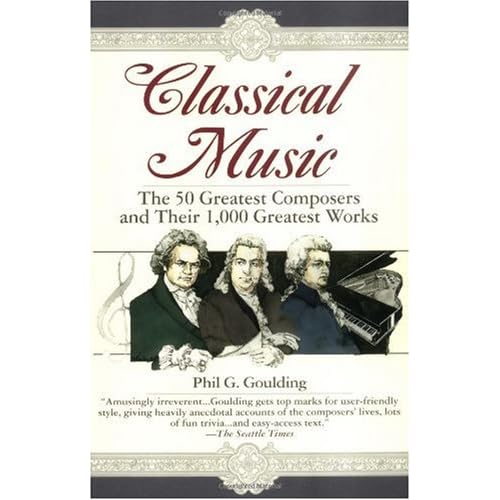
    Anyway, I made a playlist in Spotify based on his recommendations for each and one of the 50 composers listed. It's comprised of 10 major works. Some are missing, like complete operas from Verdi, Wagner and Puccini, reason being that I'm very well acquainted with them. Some other complete operas are there, though.

    Initially, I also went after his specific recommendations regarding the recording itself, the conductor and orchestra and all that, but soon i gave that up. Just laziness, I guess. ;)"


    Coincidentally, the Chinese translation of Goulding's book was one of the very first books I've read on classical music, and I think it's a good introduction too. If not for Jorge we would not be able to get this wonderful playlist that put the core repertoire of Western classical music in one place. Thanks Jorge.

    Here's Jorge's Spotify playlist: Phil G. Goulding Classical Music (4685 tracks, 2 weeks) 10 major works each from 50 most important composers according to Goulding, a relatively conservative but very decent list, you will need to know these works well before you go beyond them. As The Dalai Lama says: "Know the rules well, so you can break them effectively."

    And these are links to mreddington, piaf123456, jahart and bonving who have generously contributed guest playlists before, you can find lots of interesting playlists in their public profiles.


    Monday, April 12, 2010

    Spellbound: The Sound of The Theremin

    Another guest playlist! I got an email from Martin last weekend:

    "A couple of contemporary female composers you might like to add to your excellent playlist on this are the Austrian Olga Neuwirth and the Japanese Misato Mochizuki. There is little on Spotify but you will find one piece by Mochizuki and some music for Theremin by Olga Neuwirth."

    "Since I mentioned the Theremin in my last mail I thought you might be interested in this playlist of music for this little known and very bizarre electronic instrument that has been used to play very romantic pieces as well as inspired some composers to use it in contemporary works."


    I have added in those two composers into the women composers playlist. And thanks to Martin, I finally found out about this peculiar thing that played that dreamy and quirky sound in Hitchcock's Spellbound. I've heard one piece by Clara Rockmore before, in a interesting compilation called OHM- The Gurus of Electronic Music, and I always remembered it as Trip-Hop of the 1940s. It's great that now I can explore a whole lot of works written for and performed on this instrument.

    Here's the Spotify playlist from Martin: Theremin. (90 tracks, 6.9 hours). Thanks Martin! I think instrument playlists is a great idea, I'm going to make some others, and if any of the readers here is specialized in any instrument, it would be great to see your playlists too:)


    Thursday, April 8, 2010

    Guest Playlist: Gerald Finzi's Complete Works

    I've got quite a few emails about this blog recently, and today I received a playlist from a very kind classical listener and Spotify user. It's the complete work of 20th-century British composer: Gerald Finzi. John wrote in his email:

    "I was first attracted to him because a friend's daughter was playing the Clarinet Concerto in an amateur concert. This led me on to his other orchestral works, then his songs."


    I think that might be a good way to explore Finzi's works. Here's the Spotify playlist: Gerald Finzi (112 tracks, 7.9 hours) Thank you, John:) I'm listening to the Cello Concerto now and it's a great discover, looking forward to see more from you and the others.


    Saturday, March 6, 2010

    Borrowed Playlist: The Swedish Romantic Composers

    Spotify is a great service started from Sweden, so I always wanted to make a playlist of Swedish composers. This morning I found a wonderful playlist on Gehrmans' Twitter, and I've been listening to it all day, really love these lush orchestral pieces with soaring Nordic melodies! Here's the links to the biographies of the composers in this playlist:

    Lars-Erik Vilner Larsson (1908-1986)
    Hilding Rosenberg (1892-1985)
    Hugo Emil Alfvén  (1872-1960)
    Franz Adolf Berwald (1796-1868)
    Karl-Birger Blomdahl (1916-1968)
    Daniel Börtz (1943- )
    Thomas Jennefelt (1954- )
    Fredrik Högberg (1971- )
    Eduard Tubin (1905-1982)
    Nils Lindberg (1933- )

    You can find the sheet music from the publisher Gehrmans Musikförla

    Here's the Spotify playlist: Published by Gehrmans Musikförlag (172 tracks, 13.8 hours) Happy listening and have a nice weekend.