Wednesday, February 29, 2012

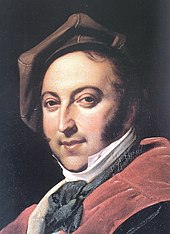
Gioachino Rossini: Complete Operas & Other Works

"The point is... a person feels good listening to Rossini. All you feel like listening to Beethoven is going out and invading Poland. Ode to Joy indeed. The man didn't even have a sense of humor. I tell you... there is more of the Sublime in the snare-drum part of the La Gazza Ladra than in the whole Ninth Symphony."  -- Thomas Pynchon, Gravity's Rainbow

"The first characteristic of Rossini's music is speed -- a speed which removes from the soul all the sombre emotions that are so powerfully evoked within us by the slow strains in Mozart. I find also in Rossini a cool freshness, which, measure by measure, makes us smile with delight." -- Stendhal , Life of Rossini

Happy 53rd birthday
This playlist collects Italian composer Gioachino Rossini's complete works.It starts with Giulini's classic recording of the overtures; then I put in the complete operas in chronological order, as listed here (most of his 39 operas are available on Spotify); after the last opera William Tell, composed when Rossini was only 37 and was going to live another 39 years, you can find all the sacred music, chamber music, songs, and some instrumental and piano pieces. For Petite Messe Solennelle (1863) I included two recordings: the original version played on Pleyels built in 1858 and 1869, and a harmonium from 1878; and the orchestrated version. At the end there is Chailly's Rossini Discoveries (now out of print), which features seven world premiere recordings of rarities.

Here's the Spotify playlist: Gioachino Rossini: Complete Operas & Other Works (1476 tracks, total time: 100 hours) Ctrl (CMD)+G to browse in album view. Most tracks are available on both Spotify Europe and USA. Also check out my previous Naxos Educational playlist for Opera Explained - The Barber Of Seville & Tancredi.


Thursday, February 23, 2012

Spotify's New Feature: Gapless Playback

Today Spotify added gapless playback, probably the most wanted feature among classical fans. If your desktop hasn't been automatically updated, you can get the new version here.


A few examples to showcase this great new feature:

Stockhausen's monumental work for six vocalists and six microphones, Stimmung. Over 70 minutes long, in 51 tracks, now with no gaps in between!

Live albums sounds so much better without gaps. Check out the last three track from Grateful Dead's Europe '72 Vol. 2, one of the most exciting encores ever.

Concept albums are now presently properly too, from What's Going On to Deltron 3030, from The Ninth Wave (the second half of Hounds Of Love) to The Downward Spiral, all those annoying gaps are gone for good.

If the short pause between the third and fourth movement of Beethoven's fifth Symphony made you wanted to bang your head on the desk, rejoice now, those days are gone and gone forever. Listen to The Fifth, or any symphony smoothly as one whole piece of work now. If you don't know where to start, check out my previous post: ABC Classic FM's Classic 100 Symphony.

And yes operas! Finally you can listen to a Wagner piece as three hours of contentious music without interrupting of any kind (provided you've turned off the phone and Twitter). Go search for an opera, or pick up one from my Wagner, Puccini, Strauss, Britten or Mozart playlist.

Electronic music/DJ mixes also benefits greatly from this feature, follow @afront and check out his blog for tips on that. 

All album examples are linked to Spotify. Try it for yourself and look forward to your recommendations.

Tuesday, February 21, 2012

W. H. Auden in Music

A verbal art like poetry is reflective; it stops to think. Music is immediate, it goes on to become. - W. H. Auden

"Much of his poetry is concerned with moral issues and evidences a strong political, social, and psychological context. While the teachings of Marx and Freud weighed heavily in his early work, they later gave way to religious and spiritual influences. Some critics have called Auden an “antiromantic”—a poet of analytical clarity who sought for order, for universal patterns of human existence. Auden’s poetry is considered versatile and inventive, ranging from the tersely epigrammatic to book-length verse, and incorporating a vast range of scientific knowledge." Poetry Foundation

To celebrated Auden's 105th birthday, I put together a playlist of music based on his poems and translations, including Auden songs from Barber, Britten (Fish in the Unruffled Lakes), Foss (We're Late), Henze, Rorem and many more; libretti, including The Rake's Progress and Elegy for Young Lovers; and compositions inspired by his writings, like Bernstein's Symphony No. 2 The Age of Anxiety.I also included jazz pianist Andreas Schnermann's Tell Me The Truth About Love, which set 12 Auden poems to music.

Here's the Spotify playlist: W.H. Auden in Music (163 tracks, total time: 9 hours). Ctrl (CMD)+G to browse in album view. See song texts here. For further readings, I wholeheartedly recommend his prose collection: The Dyer's Hand, one of the best books on reading, writing, Shakespeare and music that I have read, and this blog post: W.H. Auden as Muse. You can also hear Auden reading his poems from this previous playlist.


Wednesday, February 8, 2012

Rainer Maria Rilke in Music

Music. The breathing of statues. Perhaps:  
The quiet of images. You, language where 
languages end. You, time  
standing straight from the direction  
of transpiring hearts.


"Rainer Maria Rilke (1875 –1926), was a Bohemian–Austrian poet. He is considered one of the most significant poets in the German language. His haunting images focus on the difficulty of communion with the ineffable in an age of disbelief, solitude, and profound anxiety: themes that tend to position him as a transitional figure between the traditional and the modernist poets." - Wikipedia

"By sheer dint of prayer, I knew bread."
"Rilke's conservative forms, lyrical diction, rhyme and brevity are qualities that have historically commended themselves to the masters of the German lied, but prolific ones like Richard Strauss, Hans Pfitzner and Othmar Schoeck ignored Rilke and turned readily, among contemporary writers, to Hermann Hesse, whose purely poetic gifts were of a lesser order.

The modernists dabbled: Schoenberg, Berg and Webern each set a Rilke lyric or two, but with unmemorable or sometimes jarring results. Paul Hindemith made a cycle of "The Life of Mary" that many admire. But the list is very short.

Rilke is by far the most-read German poet in English translation; there are at least 12 translations of the sonnets alone, most of them still in print, and when the poet's name comes up in Woody Allen's "Husbands and Wives," it isn't an obscure reference. Yet though there must have been some previous American or British settings of the sonnets, none has come my way." - NYT, A 'Musician' in Spite of Himself

Though the author is on record as having only contempt for musical settings of his work, many more Rilke settings were composed and recorded since the above 1992 NYT article; I collected more than 60 classical works for this playlist. Not all of them are masterpieces that are worthy of the original text; I put my favourite ones at the beginning: Morten Lauridsen's Chansons des Roses, Krenek's O Lacrymosa, and Lieberson's Rilke Songs. Other notable works include: Brad Mehldau's Love Sublime, Rautavaara's setting of the first Duino Elegies, three settings of Sonnets to Orpheus (by Rautavaara, Danielpour and Eric Moe), and four settings of Rilke's only major prose poem: The Lay of the Love and Death of Cornet Christopher Rilke (by Earl Kim, Frank Martin, Viktor Ullmann and Paul von Klenau).

Here's the Spotify playlist: Rainer Maria Rilke in Music (336 tracks, total time: 20 hours) Ctrl (CMD)+G to browse in album view. See song texts here. For further readings, I recommend any good anthology with Letters to a Young Poet, and The Complete French Poems.


Sunday, February 5, 2012

Spotify Hidden Feature: Playlist Search

I wrote about how to use advance search to look for classical music on Spotify before; Spotify's official site also offers various examples of wildcard searches. Today I discovered a hidden feature in Spotify's desktop app: playlist search.

Example 1: playlist:pitchfork


I browsed the five results in the first page, they are all quite popular (8k+ subscribers), but strangely, no playlists from Pitchfork's official account was shown in the first ten pages of results (even though this one has 35k+ subscribers). Apparently, the reason is, there's no "pitchfork" in the titles of those playlists.

Example 2: playlist:mozart


Here begins the confusion. It shows a list of seemingly random playlists - many of them have no subscribers at all. I am not going to browse through a list of playlists titled just Mozart unless I'm really bored, and I doubt many users will. I didn't see my Mozart Chronological Catalogue playlist (800+ subscribers) in the first 10 pages of results, and couldn't find anything when I searched for "Mozart catalogue".

Example 3: playlist:tom moon


My intention was to find out if other users could find my 1,000 Recordings To Hear Before You Die Based on Tom Moon's Book playlist (1.7k+ subscribers) through playlist search. The answer is negative - it only shows dozens of playlists consist of only one album: Tom Petty's Full Moon Fever. This brings up another problem in Spotify: the unwanted one-album playlists.

Why would users create a playlist for a single album? Because they have to; there's simply no other way to save an album for further listening. Playlist management is always a weakness in Spotify, after a user created dozens or hundreds of playlists, it becomes really hard to look for or even remember what's in the library. Creating a "favourite albums" playlist partly solves the problem, but I think Spotify could add a simple function that vastly improves the user experience, for now I call it My Collection.

We create and subscribe to various playlists for rainy days, parties, holidays, etc., all tracks in those playlists go into our Spotify Library, but I think many of us also treasure the notion of a personal music collection, consists of only the albums/tracks we really think as "our music", i.e. those we would buy before music subscription comes into being. What I suggest is: add an "Add" button for tracks, albums and even artists, and show music added to My Collection is grid view, as in Devices (see image below).


I don't think it's the same as Starred tracks, which would become hard to browse after I added in hundreds of albums; it also cannot hold more than 10,000 tracks. For unknown reasons, users can no longer star an album in the latest version of Spotify.

This Collection function also creates useful stats for Spotify: how many users added a particular track/album to their collections; how many followed (added to collection) an artist. They can also add another handy function here: show new releases/newly added recordings from an artist to their Spotify followers as a unread (unheard?) count in their icons in the grid view. How many times did we stumble upon a promising release from an unknown band every year, and how do we keep track of their follow-ups? Why do I need a 3rd party service to tell me a new Radiohead or Leonard Cohen album has become available on Spotify? This function improves user experience, as well as offering the musicians a chance to gain loyalty, other than one-time exposure.

I think Spotify is still working on playlist search (hence the hidden-ness); hope it becomes a truly useful function soon.

Friday, January 27, 2012

Wolfgang Amadeus Mozart: Complete Chronological Catalogue on Spotify, Version 2.0

"We cannot despair about mankind knowing that Mozart was a man."  - Albert Einstein

I compiled first version of this playlist in July, 2010, it was the Philips's 180-CD Complete Mozart Edition rearranged in chronological order. I totally remade it last month, because: 1, I want to add more variety into this playlist; 2, About half of the Philips recordings are not available in Spotify USA. 3, There are dozens of works are not recorded for the Philips Edition, including newly discovered pieces.

After the remake/expansion, this playlists now include 2802 tracks from more than 470 recordings, covering most of the excellent Mozart interpreters and important recordings from the stereo era that I know of, and most of the tracks are now available in both Spotify UK and USA.

I tried to find all of Mozart works in recorded form. The criteria for inclusion are: 1, all works included in the Philips Edition, even a few works (like K44) are not authentic; 2, all fragments and unfinished works should be here, in their original form when possible (I have to include the completed version of the Requiem, but another recording of only the notes written by Mozart is also featured); 3, all doubtful works, unless they are proved definitely spurious (like Symphony No. 2 & 3), are included. In addition to all works listed in the main list of the Köchel catalogue, this playlist also contains these works below:

K44/K73u, Cibavit eos
K61h, Minuet
K72a, Piano Sonata in G
K74g/K.Anh 216, Symphony in Bb
K91/K186i, Kyrie in D
K142, Tatum ergo in Bb
K196e & K196f, Wind Octets in Eb and Bb
K197, Tatum ergo in D
K198, Offertory "Sub Tuum Praesidium"
K223/K166e, The Osanna (and sketches on same page)
K288/K246c, Fragment of a Divertimento in F
K293/K416f, Oboe Concerto Fragment
K293e, "19 Coloratura Cadenzas to J.C. Bach Arias"
K297b/K.Anh C14.01, 4-Wind Sinfonia Concertante
K299c, Fragmentary Ballet Pieces
K299d/K.Anh 103, The "Chasse"
K312/189i/590d, Piano Sonata Fragment in G
K314, Flute Concerto in D, 2 Versions
K315a - K315g, 8 Minuets
K320e, The Sinfonia Concertante for Violin, Viola, Cello
K322, Kyrie in Eb
K323, Kyrie in C
K357, 4-Hand Piano Sonata
K370b, Horn Concerto
K375b, c & d/K.Anh 42, 43 & 45, Two 2-piano fragments
K396, Sonata movement or Fantasia
K403/K385c, K404/K385d, K402/K385e, Pieces for Piano and Violin
K426a/K.Anh 44, Allegro in c-minor for 2-pianos
K429/K468a, Cantata, Dir Seele des Weltalls
K440/K383h, Soprano Aria "In te spero, o sposo amato"
K442, 3 Fragments of Piano Trios in d-minor, G, and D
K443/K404b, Trio-Sonata Fugue in G
K446, Pantomime Music
K452a/K.Anh 54, Larghetto in B flat for Piano, Oboe, Clarinet, Basset Horn and Bassoon
K464a/K.Anh 72, Rondo movement in A
K484b/K.Anh 95, Fragment for Wind
K484e, Fragment of Allegro for Bassetthorn
K494a/K.Anh 98A, Horn Concerto fragment in E major
K498a/K.Anh 136, Piano Sonata in Bb
K514a/K.Anh 80, Movement for 2 Violins, 2 Violas, and Cello in B-flat
K515c/K.Anh 79, String Quintet Fragment in A
K516c/K.Anh 91, Clarinet Quintet Fragment
K535b/K.Anh 107, Fragment of a Contredance
K562e/K.Anh66, Fragment for String Trio
K565a, Contredance
K580a/K.Anh94, Adagio for 4 Instruments
K580b/K.Anh 90, Clarinet/Bassethorn Quintet in F
K589a/K.Anh 68, Fragments for the Final Movement of this String Quartet
K621a/K.Anh 245, The Aria "Io ti lascio"
K621b, Fragment of Bassetthorn Concerto in G
K623a, Austrian National Hymn
K.Anh 138, Andante variatio
K.Anh 137, Piano Variations on Clarinet Quintet K581
K.deest, Soprano Aria "Cara. Se le mio pene"
K.deest, Symphony"Neue Lambacher"
K.deest, Larghetto and Allegro for 2-Pianos in Eb
K.deest, "Modulating Prelude"
K.deest, Interval Canons

Notes:

Anhang I: Lost authentic compositions (Anh. 1 - 11)
Anhang II: Fragmentary Compositions (Anh. 12 - 109)
Anhang III: Transcribed works by others (Anh. 110 - 184)
Anhang IV: Doubtful Compositions (Anh. 185 - 231)
Anhang V: Spurious Compositions (Anh 232 - 294)

I included all the Bach arrangements in their entirety, as for Mozart's arrangement of Handel's oratorios (K566, 572, 591, 592) I only put in one track per piece.

Here's the Spotify playlists: Wolfgang Amadeus Mozart: Complete Chronological Catalogue based on K6 (2802 tracks, from more than 370 artists, on more than 470 recordings, total time: 190 hours) Ctrl (CMD)+G to browse in album view. Works are arranged in chronological order based on the 6th edition of the Köchel catalogue, for works not listed there, I consulted various online sources and Hermann Abert's definite biography W.A. Mozart, but I am no expert, please leave a comment if you find any mistakes in the track order, or find anything that I left over. Thank you.

More references: Main Köchel, Mini Köchel, list of Fragment Recordings, what's on and not on the Philips Edition.

You can use this playlist to play the Mozart Game, or create as many smaller playlist as you want: just press Ctrl(CMD)+F to bring out the filter bar, then input, say, oboe:

You get all the Mozart works for oboe.


or Horn:
 

Flute:


Clarinet:


Piano:


Piano Concerto:


For unknown reasons, Spotify took out the stats from the filter bar, and now you cannot see those track/artists/albums numbers. The screenshots were taken with the previous version of Spotify. Also please note these sub-playlists are not as exhaustive as the main list, as tracks on Spotify are tagged by different labels using their own methods, for example: some piano sonatas are tagged as "keyboard sonatas".

If you miss the old one based on the Philips Edition, here's another Spotify playlist: Philips Complete Compact Mozart Edition - 17 Box-sets (2636 tracks, total time: 180 hours)

Happy birthday Wolfie, thank you for the music.

Thursday, January 26, 2012

Songs of Bob Dylan: After Clinton Heylin's Chronological List

To celebrate Bob Dylan's return to Spotify, I compiled a chronological playlist of songs written by the master, after renowned Dylanlogist Clinton Heylin's two volume companion to every Dylan song from 1957 to 2006: Revolution In The Air and Still On The Road.


Mostly I use Dylan's studio takes for the playlist, with a few live recordings/demos from the official bootleg series, like It's All Over Now Baby Blue & Visions of Johanna from the "Royal Albert Hall" Concert, and a studio outtake of Born In Time - like the other dozen or so outtakes of this song circulating among bootleggers, it sounds vastly superior to the version appeared on the album. Heylin's list ends at 2006, I also included the 2009 album Together Through Life and The Love That Faded from 2011's The Lost Notebooks of Hank Williams. Please note no covers are included here - though Dylan's two recordings of traditional folk songs from the early 1990s are up there with Cash's American Recordings - on the other hand, a few songs performed by other artists are included, like Love Is Just A Four-Letter Word sang by Joan Baez, because Dylan never officially recorded it.

Here's the Spotify playlist: Songs of Bob Dylan: After Clinton Heylin's Chronological List (392 tracks, total time: 30 hours) (CMD)+G to browse in album view.

Also check out this awesome blog: Every Bob Dylan Song.


Friday, January 20, 2012

EMI 20th Century Classics on Spotify

This series features recordings of both popular and rare 20th Century works. All are 2CD releases, with the repertoire taken from both the EMI and Virgin Classics catalogues. It offers a wonderful introduction to the more accessible classical music from the last century, and also covers the some of the most famous avant-gardists.


EMI listed 44 titles in their official site, but thanks to Mark Whitehead, I found more than 60 titles on Spotify. Composers features in this series include: Bartók (3 volumes), Berg, Britten, Debussy, Delius, Dukas, Dutilleux, Elgar, Enescu, Falla, Glazunov, Hartmann (2 volumes), Henze, Hindemith (2 volumes), Holst, Honegger, Ibert, Janácek, Khachaturian, Kodaly, Korngold, Ligeti, Lutoslawski, Messiaen, Milhaud, Nielsen (2 volumes), Orff, Pärt, Penderecki, Poulenc, Prokofiev (2 volumes), Rachmaninoff, Ravel, Respighi, Rodrigo, Roussel, Satie, Schoenberg, Schreker, Scriabin, Shostakovich (2 volumes), Sibelius, Stockhausen, Stravinsky, Suk, Szymanowski, Tavener, Tcherepnin, Tippett, Villa-Lobos, Walton, Weill, R.V. Williams, Xenakis, Zemlinsky (2 volumes).

Here's the Spotify playlist: EMI: 20th Century Classics (1785 tracks, total time: 152 hours) Ctrl (CMD)+G to browse in album view. Albums are sorted by composer names, as listed above.


Monday, January 16, 2012

Guest Post: The Art of Binary, or Music To Code To - Domenico Scarlatti's 555 Keyboard Sonatas

Marc van Oostendorp is a Professor of Phonology - that is: the study of the sound systems of human languages - in Leiden, the Netherlands, a lover of music and a Spotify enthusiast.

--------------------

Many things are unknown about the Italian composer Domenico Scarlatti (1685-1757). During the first half of his life he lived in Italy and in the shadow of his father Alessandro (1660-1725), who was a much more famous (and productive) composer at the time, even though he is now less well-known than his son. The second half of Domenico’s life was spent on the Iberian peninsula. He worked at the Portuguese and Spanish courts, probably mainly as a music teacher to the Portuguese princess Marie Barbara de Bragance. During these last decades he also worked on what is now considered his most important work: over 550 keyboard sonatas (written originally for the harpsichord or pianoforte, but now performed on other instruments as well).

Although Scarlatti has always remained less famous than Johann Sebastian Bach or Georg Friedrich Handel, his sonatas enjoy a great reputation among lovers of the piano and the clavecin. The recording which the French pianist Alexandre Tharaud released earlier this year is generally considered to be one of the best classical cds to have appeared in 2011.

In 1953, the harpsichordist Ralph Kirkpatrick published a catalogue of all Scarlatti sonatas known to him; this is still considered to be the most authoritative catalogue. Numbers from this catalogue (1-555) are usually prefixed by K or Kk.

I know of one complete edition of all ‘Kirkpatrick’ sonatas: the recordings made by the British harpsichordist Richard Lester. I made a different playlist of all Scarlatti Keyboard Sonatas (579 track, total time: 1 day. Including a few not in Kirkpatrick), which is more varied: I tried to include as many different keyboard players as I could find, and also included recordings by guitarists, harpists, and even a violinist and a saxophone quartet. I also made a separate playlist of Scarlatti Sonata K9, as played by 28 different musicians.

As a bonus, the Petrucci library offers free musical scores of all sonatas. A very nice website is also the one by Christopher Hail, which offers among other things a great catalogue (pdf), plus a Calendar for 2012, with a suggestion for every day on which sonata to listen to (something done in 2010 by blogger Mimo).

Guest post by Marc van Oostendorp


Sunday, January 8, 2012

1000 Recordings to Hear Before You Die: A Spotify Playlist after Tom Moon's Book

"This is a book both broad and deep, drawing from the diverse worlds of classical, jazz, rock, pop, blues, country, folk, musicals, hip-hop, world, opera, soundtracks, and more. It's arranged alphabetically by artist to create the kind of unexpected juxtapositions that break down genre bias and broaden listeners' horizons— it makes every listener a seeker, actively pursuing new artists and new sounds, and reconfirming the greatness of the classics. Flanking J. S. Bach and his six entries, for example, are the little-known R&B singer Baby Huey and the '80s Rastafarian hard-core punk band Bad Brains. Farther down the list: The Band, Samuel Barber, Cecelia Bartoli, Count Basie, and Afropop star Waldemer Bastos."

"The goal, Moon writes in the introduction, is to spark curiosity about music —all forms of music. 'There's great treasure waiting on the other side of wherever you draw your territorial lines.'" - official site


I bought Tom Moon's 1000 Recordings To Hear Before You Die yesterday when it's featured on Kindle Store's daily deal. After skimming though the list, I was happy that there's tons of stuff I didn't know, and I liked most of the recordings I did know. My only complain, aside from Tommy made into the list instead of Quadrophenia, was that it didn't come with a Spotify playlist. Well, you can guess the rest.

Here's the Spotify Playlist: 1000 Recordings to Hear Before You Die (Tom Moon): An Index (805 tracks from 805 recordings). Ctrl (CMD)+G to browse in album view, and use the filter bar (Ctrl+F) to look for recordings. See complete list with essays here or download it as a pdf. Most of Moon's selections are albums, I kept only one track per recording for practical reasons: to get rid of the 10,000 tracks limitation, and keep the playlist easy to browse. I didn't mean to make it into a singles playlist, so I chose the tracks from albums rather randomly. Most recordings here deserve to be listened in their entirety.

Why only 805 recordings? Well, some artists like the Beatles and Led Zeppelin are not on Spotify yet. Also, I only included albums exactly matched the list. For example, Serkin's Complete Beethoven Piano Concerto with Ozawa is available, but the book recommends his earlier recordings with Kubelik; Spotify has many recordings of Oum Kalthoum, including a gigantic 26-CD set, but the very compilation listed in the book, Legend of Arab Music,  is not available, in both cases I didn't include them into this playlist. My goal is to create a playlist for the readers of the book, and people who are curious to explore, so I don't think any addition or alteration to the original list is necessary.